Saturday, November 29, 2025

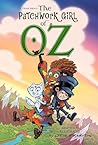
Book Review: The Patchwork Girl of Oz (Volume 1): A Graphic Novel Adaptation by Otis Frampton

The Patchwork Girl of Oz Volume 1: A Graphic Novel AdaptationThe Patchwork Girl of Oz Volume 1: A Graphic Novel Adaptation by Otis Frampton
My rating: 5 of 5 stars

The Patchwork Girl of Oz is the seventh book of L. Frank Baum’s Oz series of children’s books that artist and adaptor Otis Frampton is bringing back into broad public consciousness in his wonderful artist style. This first volume is a collection of the five individual comic issues Frampton published that covers the first six chapters of Baum’s book. In them we are introduced to our three main protagonists—Ojo the Unlucky, Scraps the titular the Patchwork Girl, and the Glass Cat—through various means and see the inciting incident that forces the three to undertake a quest to save Ojo’s uncle and Scraps’ mistress after they’re turned to stone. The designs for all three main characters are excellent as is his page layout along with his background artwork that brings the Land of Oz to life, there is a reason I am a longtime fan of Frampton’s work and once again I’m not disappointed. Though I knew of the most famous book of the Oz series given it’s many adaptations and references in culture—including a certain Broadway play turned two film franchise of recent—this particular installment I had never heard of and allowed to me an introduction to the greater landscape of Oz, which hopefully will be the same for children of all ages.

View all my reviews

Friday, November 28, 2025

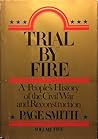
Book Review: Trial by Fire by Page Smith

Trial by Fire: A People's History of the Civil War & Reconstruction (Vol 5)Trial by Fire: A People's History of the Civil War & Reconstruction by Page Smith
My rating: 3 of 5 stars

There are three eras during which the future of the nation was at stake, in the 18th century it was the Revolution and in the 19th century it was Civil War. Trial by Fire: A People’s History of the Civil War and Reconstruction is the fifth volume of Page Smith’s A People’s History series from Fort Sumter to the election of 1876 as the nation is racked by four years of war to successfully save the Union and 11 years of Reconstruction that failed to bring the freedman truly within body politic short-term but creating a promissory note for the future.

This volume is by the nature of its emphasis in a particularly 15-year period of the nation’s history different from Smith’s previous volumes in terms of scope in military, political, and cultural elements. Over the nearly 1000 pages of text, Smith not only detailed the events of the war along the twists and turns of Reconstruction to correct the record of the period that the “Lost Cause” myth perpetuated about the period over the course of over half a century. Among the most important parts of the book was Smith’s concluding analysis of both the war and Reconstruction: when writing about the former Smith concluded that the South probably should have won given various factors at the beginning of the war but poor strategic decisions by the South allowed the North’s numbers and industrial capacity overwhelm it while the later was always doomed to fail due to Southern intransigence and the fact Northern opinion of blacks was negative Reconstruction needed to be attempted because the alternative would have been emphatically worse. While the overall product was very well written and very informative, Smith made a lot of head scratching mistakes that stood out because they were contradicted by the actual facts just paragraphs later which appears to be sloppy editing by someone because it was blatant that something happened between first draft manuscript and ready for publication proof that allowed these errors to creep in. The fact that I downgraded the rating an entire star compared to the previous volumes is an indication of how much it got my attention.

Trial by Fire is a culmination of events that Page Smith chronicled in his history of the United States as the two conflicting views of what the country clashed and its aftermath that created a more “national” though still incomplete vision of the country that would lead into it’s next chapter.

View all my reviews

Monday, November 10, 2025

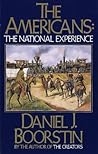
Book Review: The Americans: The National Experience by Daniel J. Boorstin

The Americans, Vol. 2: The National ExperienceThe Americans, Vol. 2: The National Experience by Daniel J. Boorstin
My rating: 3 of 5 stars

In the first half of the 19th Century, the United States expanded demographically, geographically, and culturally that it had changed nation on the eve the Civil War. The Americans: The National Experience is the second volume of Daniel J. Boorstin’s trilogy which features the American experience as it politically evolved from thirteen independent states into a continent spanning nation that was societally bring ripped apart by a part of the population and view of what the Union was.

Over the course of 430 pages Boorstin covers everything how communities evolved, expanded geographically, and atrophied in various ways to how nationality was created from borders, language—spoken and written—was shaped, symbols, and finally in political views of what the Constitution meant for unionism. There were several takeaways from this volume that I found intriguing, first was that Boorstin popped a whole in myth of the lone individual that pulled himself up by the bootstraps or expanded America knowledge of what was just around the next rise, Boorstin spent several chapters revealing how without a community—whether it be a town, a church, a business, etc.—the individual was lost. The second was how English common law’s silence on slavery allowed it to be planted the colonies and grow in the new nation. Third was the views of the Constitution and Union, which ultimately in conjunction with community and slavery led to a civil war. It was fascinating upon finishing this book to see how Boorstin had constructed it to appear that he was covering various topics that seemed loosely related only to find them essential to one another in the end. The book was unfortunately not perfect as there was several mistakes in dates and one very noticeable anachronism—Boorstin highlights a meeting that included Seventh-Day Adventists in 1840 which was impossible through one might think he meant an Millerite Adventists that worshipped on the Sabbath but that would be really filtered down—that should not have survived so many editions since the book was first published in 1965. Overall, this second volume of Boorstin’s exploration of the American experience is very thought-provoking for anyone interested in reading about a grand view of American history.

The Americans: The National Experience is a view of the country from independence to the eve of civil war written by Daniel J. Boorstin.

View all my reviews