Monday, December 22, 2025

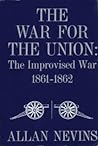
Book Review: The War for the Union, Volume I: The Improvised War, 1861-1862 by Allan Nevins

The War for the Union: The Improvised War, 1861-62The War for the Union: The Improvised War, 1861-62 by Allan Nevins
My rating: 4 of 5 stars

It was a conflict that seemed to be destined to occur for years, but neither side was particularly ready for when it happened even though one side had been preaching for while to be independent and didn’t prepare. The War for the Union, Volume I: The Improvised War, 1861-1862 is the fifth book of Allan Nevin’s Ordeal of the Union series as the war that appeared inevitable after secession start but in a haphazard fashion that leaves both sides scrambling to raise, arm, and supply men while fighting one another.

Through 416 pages of text, Nevins details the lead up to and the fallout of the firing of Ft. Sumter that resulted in Lincoln’s call for volunteers which sent almost half of the border states into the Confederacy and how both sides figured out how to fight a war. As Nevins expertly relates while contemporary feeling—from both sides—demanded fighting, logistically it wasn’t so simple as arming men and getting them arms to fight with and supplies to live on were a challenge early on. The challenges, especially with political considerations for Lincoln, to getting raised troops to where they were needed and how state governments more than the underdeveloped U.S. government were essential early on. Nevins focuses on fighting when it needs to, but this volume is dedicated to revealing about how unorganized either side was to even fight and thus why 1861 is comparatively bloodless. The struggle to get arms and supplies leading to both sides contracting foreign contractors is enlightening and Nevins analysis on how both sides did was very informative. Besides the arming and logistics information, Nevins goes into the political maneuvering that was new to me especially in Missouri and how the Blair family cost the Federal war effort three-years of guerilla warfare due to their machinations when the state could have been firmly pacified by the end of the year. Nevins also goes into how each side, though mainly the Federals, squandered opportunities to get easy victories that would quiet public demand for action and improved strategic lines for defense of important areas even if the lines moved a few miles. Overall, this volume while “light” on fighting shows the forgotten importance of supplies and logistics when it comes to warfare in this period.

The War for the Union, Volume I: The Improvised War, 1861-1862 reveals how two political factions switched from talking to fighting and Allan Nevins reveals the complicated transition that took place to bring it about.

View all my reviews

Wednesday, December 17, 2025

Book Review: Around the World in Eighty Days by Jules Verne

Around The World In 80 DaysAround The World In 80 Days by Jules Verne
My rating: 3 of 5 stars

The second half of the 19th Century saw the world shrink for those living and fantastic speculation began to be put forth about how long it would take with improved modes of transportation to go around the Earth. Around the World in Eighty Days is one of Jules Verne’s most well-known works that follows the adventurous journey of Phileas Fogg and his servant Passepartout along with Detective Dix and Aouda who join them under various circumstances.

In a short 208 pages, Verne introduces us to our two protagonists, sets up the fantastical journey, and allows us to follow along they and additional companions attempt to get around the Earth within a specific timeframe. I wasn’t expecting the characters to be a layered, but I was surprised we had as much insight into a few of them as we did. The journey itself is filled with cliched scenes of riding an elephant in India, a Native American attack on a train while crossing the Great Plains, as well as characters—well one most of the time—doing things like the locals. The main protagonist is very English, the love interest has a tragic backstory and fawns over her rescuer, the comedic sidekick does funny stuff, and the letter-of-the-law police detective antagonist is honorable though mistaken; all the boxes were checked. Honestly, this was a quick fun read and is a classic for a reason.

Around the World in Eighty Days provides an enjoyable experience when reading, it’s a classic adventure tale chalk full of stock characters and cliché scenes but fit the time and became timeless just for that reason.

View all my reviews

Saturday, November 29, 2025

Book Review: The Patchwork Girl of Oz (Volume 1): A Graphic Novel Adaptation by Otis Frampton

The Patchwork Girl of Oz Volume 1: A Graphic Novel AdaptationThe Patchwork Girl of Oz Volume 1: A Graphic Novel Adaptation by Otis Frampton
My rating: 5 of 5 stars

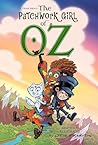
The Patchwork Girl of Oz is the seventh book of L. Frank Baum’s Oz series of children’s books that artist and adaptor Otis Frampton is bringing back into broad public consciousness in his wonderful artist style. This first volume is a collection of the five individual comic issues Frampton published that covers the first six chapters of Baum’s book. In them we are introduced to our three main protagonists—Ojo the Unlucky, Scraps the titular the Patchwork Girl, and the Glass Cat—through various means and see the inciting incident that forces the three to undertake a quest to save Ojo’s uncle and Scraps’ mistress after they’re turned to stone. The designs for all three main characters are excellent as is his page layout along with his background artwork that brings the Land of Oz to life, there is a reason I am a longtime fan of Frampton’s work and once again I’m not disappointed. Though I knew of the most famous book of the Oz series given it’s many adaptations and references in culture—including a certain Broadway play turned two film franchise of recent—this particular installment I had never heard of and allowed to me an introduction to the greater landscape of Oz, which hopefully will be the same for children of all ages.

View all my reviews

Friday, November 28, 2025

Book Review: Trial by Fire by Page Smith

Trial by Fire: A People's History of the Civil War & Reconstruction (Vol 5)Trial by Fire: A People's History of the Civil War & Reconstruction by Page Smith
My rating: 3 of 5 stars

There are three eras during which the future of the nation was at stake, in the 18th century it was the Revolution and in the 19th century it was Civil War. Trial by Fire: A People’s History of the Civil War and Reconstruction is the fifth volume of Page Smith’s A People’s History series from Fort Sumter to the election of 1876 as the nation is racked by four years of war to successfully save the Union and 11 years of Reconstruction that failed to bring the freedman truly within body politic short-term but creating a promissory note for the future.

This volume is by the nature of its emphasis in a particularly 15-year period of the nation’s history different from Smith’s previous volumes in terms of scope in military, political, and cultural elements. Over the nearly 1000 pages of text, Smith not only detailed the events of the war along the twists and turns of Reconstruction to correct the record of the period that the “Lost Cause” myth perpetuated about the period over the course of over half a century. Among the most important parts of the book was Smith’s concluding analysis of both the war and Reconstruction: when writing about the former Smith concluded that the South probably should have won given various factors at the beginning of the war but poor strategic decisions by the South allowed the North’s numbers and industrial capacity overwhelm it while the later was always doomed to fail due to Southern intransigence and the fact Northern opinion of blacks was negative Reconstruction needed to be attempted because the alternative would have been emphatically worse. While the overall product was very well written and very informative, Smith made a lot of head scratching mistakes that stood out because they were contradicted by the actual facts just paragraphs later which appears to be sloppy editing by someone because it was blatant that something happened between first draft manuscript and ready for publication proof that allowed these errors to creep in. The fact that I downgraded the rating an entire star compared to the previous volumes is an indication of how much it got my attention.

Trial by Fire is a culmination of events that Page Smith chronicled in his history of the United States as the two conflicting views of what the country clashed and its aftermath that created a more “national” though still incomplete vision of the country that would lead into it’s next chapter.

View all my reviews

Monday, November 10, 2025

Book Review: The Americans: The National Experience by Daniel J. Boorstin

The Americans, Vol. 2: The National ExperienceThe Americans, Vol. 2: The National Experience by Daniel J. Boorstin
My rating: 3 of 5 stars

In the first half of the 19th Century, the United States expanded demographically, geographically, and culturally that it had changed nation on the eve the Civil War. The Americans: The National Experience is the second volume of Daniel J. Boorstin’s trilogy which features the American experience as it politically evolved from thirteen independent states into a continent spanning nation that was societally bring ripped apart by a part of the population and view of what the Union was.

Over the course of 430 pages Boorstin covers everything how communities evolved, expanded geographically, and atrophied in various ways to how nationality was created from borders, language—spoken and written—was shaped, symbols, and finally in political views of what the Constitution meant for unionism. There were several takeaways from this volume that I found intriguing, first was that Boorstin popped a whole in myth of the lone individual that pulled himself up by the bootstraps or expanded America knowledge of what was just around the next rise, Boorstin spent several chapters revealing how without a community—whether it be a town, a church, a business, etc.—the individual was lost. The second was how English common law’s silence on slavery allowed it to be planted the colonies and grow in the new nation. Third was the views of the Constitution and Union, which ultimately in conjunction with community and slavery led to a civil war. It was fascinating upon finishing this book to see how Boorstin had constructed it to appear that he was covering various topics that seemed loosely related only to find them essential to one another in the end. The book was unfortunately not perfect as there was several mistakes in dates and one very noticeable anachronism—Boorstin highlights a meeting that included Seventh-Day Adventists in 1840 which was impossible through one might think he meant an Millerite Adventists that worshipped on the Sabbath but that would be really filtered down—that should not have survived so many editions since the book was first published in 1965. Overall, this second volume of Boorstin’s exploration of the American experience is very thought-provoking for anyone interested in reading about a grand view of American history.

The Americans: The National Experience is a view of the country from independence to the eve of civil war written by Daniel J. Boorstin.

View all my reviews

Monday, October 27, 2025

Book Review: Hyperion by Dan Simmons

Hyperion (Hyperion Cantos, #1)Hyperion by Dan Simmons
My rating: 4 of 5 stars

In the four centuries since Old Earth was destroyed the Hegemony of Man has grown, but there is a planet in the outback beyond the Hegemony’s borders that confounds those who learn about it. Hyperion is the first book of Dan Simmons’ Hyperion Cantos and features seven pilgrims on a journey to the Time Tombs to meet the legendary and deadly Shrike.

The planet Hyperion is about to be the scene of the beginning of an interstellar war between the Hegemony of Man and the Ousters, those humans who live outside the Hegemony after migrating away from Old Earth, but the Hegemony along with the Church of the Shrike organizes one last pilgrimage of seven to visit the Shrike. The seven selected pilgrims tell their stories to one another so they can pick up clues on how to survive their encounter with the Shrike who is said to kill six pilgrims while granting the wish of the lone survivor. The pilgrim’s stories are Simmons’ framing device for giving background information to his universe while also propelling the narrative towards a climax that makes the reader want to know what happens next as they haven’t met the Shrike. The story-within-a-story a la The Canterbury Tales and allusions to English poet John Keats within the science fiction aspect of the book were interesting choices by Simmons as connecting devices throughout the book and fun to find. The overall writing and story are pretty good, and one can see why this is a highly regarded book in its genre.

Hyperion is considered one of the best science fiction novels of the 1990s and after reading the first book of Dan Simmons’ Hyperion Cantos, I can see why that is so and I’m intrigued about how he follows up in the immediate sequel.

View all my reviews

Thursday, October 23, 2025

Book Review: The Emergence of Lincoln, Volume II: Prologue to Civil War, 1859-61 by Allan Nevins

The Emergence of Lincoln: Prologue to Civil War, 1859-61The Emergence of Lincoln: Prologue to Civil War, 1859-61 by Allan Nevins
My rating: 4 of 5 stars

While 1859 seemed to be an uneasy year, there was hope that the moderates and conservatives in both North and the South had marginalized the radicals in both sections then one man’s fanaticism started the chain reaction in the South which changed the nation’s course. The Emergence of Lincoln, Volume II: Prologue to Civil War, 1859-61 is the fourth book of Allan Nevin’s Ordeal of the Union series as John Brown’s raid exasperates tensions as advocates for a Southern Confederacy whip up their faux-nationalism while Republicans aimed to nominate a moderate to ensure their victory in 1860 with no on realizing for once the South would actually walk the talk they’ve been saying for over a decade.

Through 489 pages of text and four appendices, Nevins covers the final dramatic movements as the national fabric was torn in two from John Brown’s raid, the breaking up of the Democratic Party in Charleston and Baltimore, the election of Lincoln followed by Buchanan’s month-long dithering before committing to the Union even as secessionists created a Confederacy. Nevins’ research and writing continue to be top notch, but the best part of the book was Nevin’s analysis of what led to the Civil War from page 462 to 471. Nevin’s conclusion on page 468 was simple, “The main root of the conflict (and there were minor roots) was the problem of slavery with its complementary problem of race-adjustment [emphasis Nevins],” the latter part of that quote is something that Nevins had been developing and in concluding this volume set the stage both for the upcoming war that he was to chronicle as well as the reconstruction of the nation that he planned to cover but never did. Being the final volume of Nevins’ chronicle of the lead-up to the American Civil War, the blow-by-blow account of how a nation victorious in a war that increased its size by a third staggered towards breaking apart while showing how various regions of that country changed economically and in viewing itself within the nation.

The Emergence of Lincoln, Volume II: Prologue to Civil War, 1859-61 culminates Allan Nevins’ excellent relating of the decade plus of American history from the end of the Mexican War to the verge of the Civil War.

View all my reviews