Tuesday, July 28, 2026

Book Review: Punderworld (Volume Two) by Linda Sejic

Punderworld, Vol. 2 (Punderworld, #2)Punderworld, Vol. 2 by Linda Šejić
My rating: 5 of 5 stars

So, what happens when an overprotected young goddess accidentally ends up in the Underworld with the socially inept king of the domain, what could possibly go wrong? Punderworld (Volume Two) by author-artist Linda Sejic finds Persephone and Hades attempting to get the former out of the Underworld as Demeter begins looking for her daughter.

The main arc of this volume is Persephone and Hades’ attempts to get the former out of the Underworld and back among the living so she can return to work on keeping things alive, however whatever they try it doesn’t work. This leads Hades to make a sacred oath to find a way for Persephone to leave the Underworld to reassure her, however it now endangers the Underworld itself if he can’t fulfill it. The secondary arc followed Demeter as she looked for Persephone so her daughter would agree with her side of things like always only to find her missing, which leads her to Hestia’s abode leading to a very interesting discussion that explains things and sets things up for later. Sejic includes a potential foreshadowing of how she plans to mimic the myth but in a unique way will Biblical allusions. The art is fantastic and I’m just not saying that as a superfan of Linda Sejic’s work, but in this type of media if the art isn’t good then it doesn’t help the narrative. Overall, this was a very good continuation of the Sejic’s retelling of the Persephone and Hades myth.

Punderworld (Volume Two) continues a modern retelling of the well-known myth, but with characters that are socially awkward and that adds a slight to certain character dynamics.

View all my reviews

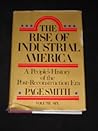
Book Review: The Rise of Industrial America by Page Smith

The Rise of Industrial America (A People's History, Vol 6)The Rise of Industrial America by Page Smith
My rating: 3 of 5 stars

After fifteen years in which the future of a portion of the populace was at stake, a deal was made that forgot them and let the country move on into a bright golden future that turned out to be just a gilded age. The Rise of Industrial America: A People’s History of the Post-Reconstruction Era is the sixth volume of Page Smith’s A People’s History series covering American history starting in 1877 to 1901 which sees capital battle labor, reformers turn their attention to numerous causes including women’s right, the rise of radicalism and populism, and finally the sudden arrival of the reform movement to power.

This volume covers a remarkable quarter of a century of history that not only shows how the nation attempted to reunite after a devastating 15-year period, but as Smith covers in almost 1000 pages as transform it into more moral nation which to many meant non-regulated capitalism. Throughout the volume, Smith’s main theme was “capital vs. labor” with side tangents on reforms a few of which admittedly did touch on that theme though many didn’t. Yet Smith quite literally skipped over a huge element that not only impacted capital and labor, but farmers, the South, the West, cities, and yes politics. Smith’s dismissing of the monetary issues—Gold Standard and Free Silver—that were embedded quickly in his chapter covering the politics of this period was part of this. In his concluding retrospective Smith says he follows the simple adage “Tell what happened” over trying to write history based on a theory, but by neglecting showing the effects of the deflation Smith removes an element that helps explain what happened. While overall Smith’s writing is fantastic as always and his analysis of cultural, societal, regional, racial and ethnic, athletic, and other numerous elements of the United States during this time period is not only top notch but informative, his lack of at least properly giving a good overall description of the economy that played a role in how things were shaped is a big hole.

The Rise of Industrial America seems to be a transitionary phase in American history from the end of the Civil War and Lincoln’s time to the rise of Theodore Roosevelt and dawn of the American Century.

View all my reviews